Short answer
Set salon service duration based on the real appointment time, not the ideal time. Include setup, consultation, cleanup, payment, and small delays when they are part of normal work. If a service often takes 60 minutes in real life, do not list it as 45 minutes just to make the calendar look fuller.
Wrong durations are one of the fastest ways to create late appointments, rushed staff, and double-booking pressure.
Who this is for
This guide is for salon owners, barbers, nail technicians, beauty rooms, and skincare studios that use online booking or want to move away from manual scheduling.
It is especially useful if your calendar looks fine on paper but feels chaotic during the day.
Why duration is more than treatment time
A service duration is not only the time your hands are actively doing the service. It is the time the appointment occupies in the calendar.
That may include:
- Greeting the client.
- Quick consultation.
- Preparation.
- The actual service.
- Processing time.
- Cleanup.
- Product notes or client notes.
- Payment and rebooking conversation.
If your calendar ignores those pieces, the day becomes too tight.
A better way to choose service duration
Use this formula:
Service duration = active work + required waiting/processing + normal transition timeThen round to a booking-friendly increment such as 15, 30, 45, 60, 75, 90, or 120 minutes.
For example:
| Service | Active work | Extra time | Better online duration |
|---|---|---|---|
| Men's haircut | 25 min | 5 min cleanup/payment | 30 min |
| Cut + styling | 40 min | 5-10 min transition | 45 or 60 min |
| Gel manicure | 50 min | 10 min removal/setup | 60 min |
| Color retouch | 70 min | 20 min processing/checkout | 90 min |
| First facial | 55 min | 10 min consultation | 60 or 75 min |
The right answer depends on your real workflow. The table is a starting point, not a rule.
Step-by-step duration audit
1. Track actual appointment time for one week
Choose your ten most booked services. For each one, write down the scheduled duration and the real time from client arrival to when the slot is truly ready for the next client.
You do not need a perfect time study. You need enough evidence to spot obvious underestimates.
2. Find services that run late often
If one service runs over more than occasionally, the duration is probably too short or the service needs clearer booking rules.
Ask:
- Is this service often booked by first-time clients?
- Does it need consultation time?
- Does it depend on hair length, nail condition, or treatment complexity?
- Should there be a short and long version?
3. Split services only when clients understand the difference
Sometimes the fix is not one longer duration. It is two clear services.
Example:
- "Gel manicure" - 60 min
- "Gel manicure with removal" - 75 min
That is clearer than forcing staff to manually adjust every appointment after it is booked.
4. Add buffers where they actually help
Do not add hidden buffers everywhere. That can reduce capacity too much. Instead, add buffer time where the risk is predictable:
- First-time consultations.
- Complex color.
- Nail art.
- Corrective skincare.
- Services before staff breaks.
Example: duration setup in Styloving
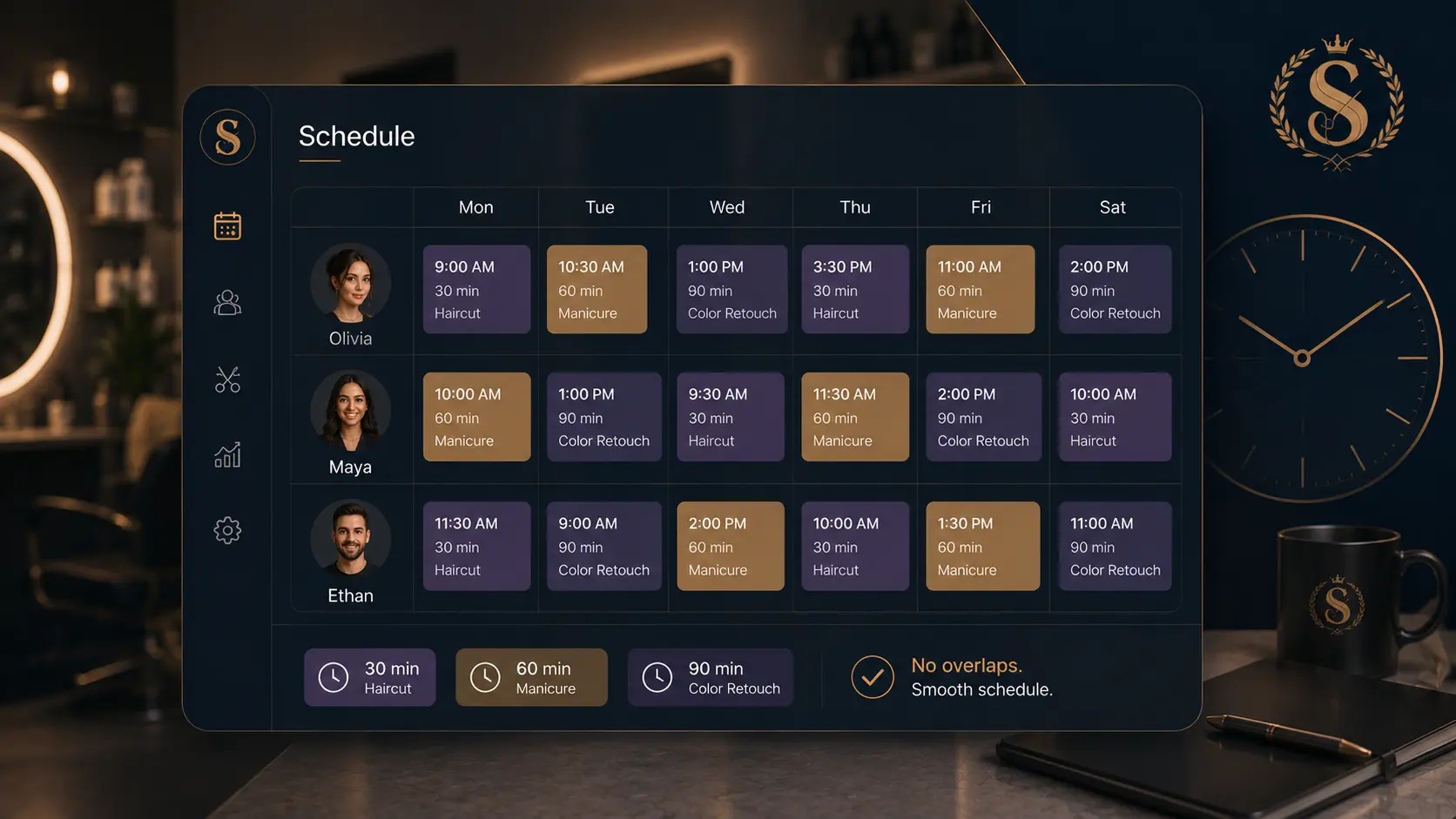
In Styloving, service duration controls how much calendar space a booking reserves. If a salon sets "Color retouch" to 90 minutes, the booking flow should not offer another overlapping appointment for that staff member during the same period.
The owner can also assign services to the staff who perform them, so duration and staff availability work together. This matters when a service is short for one staff member but longer for another. In that case, the salon may choose a standard duration or create staff-specific service options if needed.
Duration setup checklist
- List your ten most booked services.
- Compare scheduled duration with real appointment time.
- Add consultation time for complex or first-time services.
- Include cleanup and transition time where needed.
- Split services only when clients can understand the difference.
- Check that staff breaks still fit into the day.
- Test your booking flow after changing durations.
- Review durations again after two weeks.
Template: duration audit
Service:
Current duration:
Actual shortest time:
Actual average time:
Actual longest normal time:
Why it runs over:
New duration:
Need a separate version? yes/no
Need consultation first? yes/no
FAQ
Should salons use buffers between every appointment?
Not always. Buffers are useful when transition time is real and predictable. If every service needs extra time, the listed durations may simply be too short.
What if different staff work at different speeds?
Start with a realistic standard duration. If differences are large and consistent, consider separate service versions or adjust which staff can be booked for that service.
Should processing time count in the duration?
Yes, if the staff member or chair cannot be used for another appointment during that time. If another client can be served safely and realistically during processing, your scheduling setup needs to reflect that carefully.